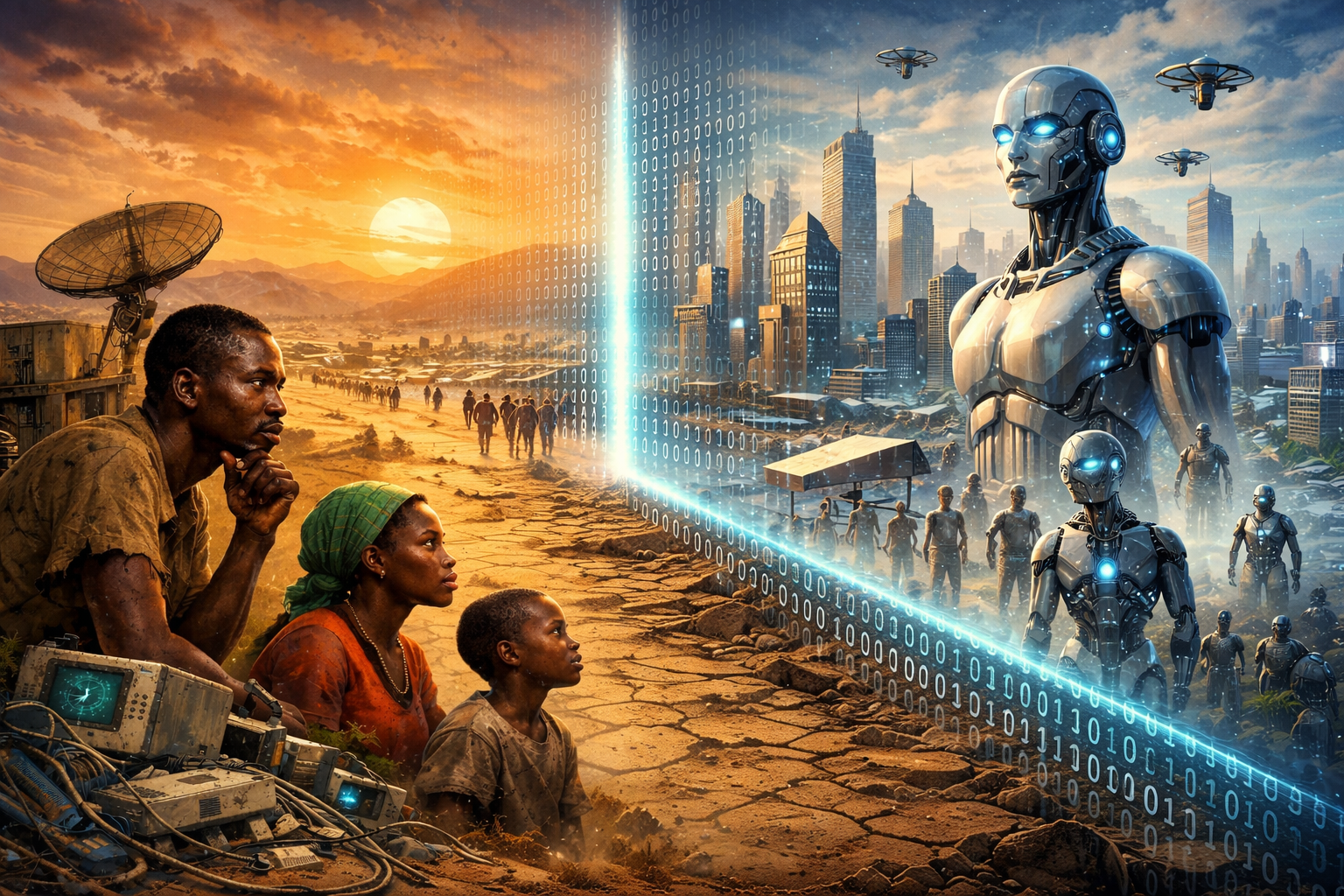
AI's Next Frontier Isn't Where You Might Expect
The world keeps looking to Silicon Valley for the future of AI. Maybe it's been looking in the wrong direction.
When most people imagine the cutting edge of artificial intelligence, they picture gleaming tech campuses in California, billion-dollar labs in London, or government-backed research centers in Beijing. They imagine supercomputers, PhD teams, and venture capital flowing like water.
They don't imagine a 24-year-old in rural Zimbabwe.
But that's exactly where Hardy Pemhiwa, President and CEO of Cassava Technologies, asks us to look. In his thought-provoking TED Talk, Pemhiwa makes a bold and compelling case: Africa isn't catching up to the AI revolution it's writing an entirely different playbook.
A Continent Built for This Moment
The numbers are striking. Africa has over one billion mobile connections and 1.1 billion mobile money accounts. Just three decades ago, 75% of Africans had never heard a phone ring. Today, the continent has leapfrogged entire generations of technology, skipping landlines and desktop computers to land directly in the mobile-first, cloud-connected world.
And then there's the demographic reality that makes the rest of the world look old by comparison. Africa is home to over 1.6 billion people, with a median age of just 19 years. These are not passive consumers of technology. They are digital natives — restless, resourceful, and hungry for tools that work for their lives.
This combination mass mobile connectivity, a youthful population, and urgent real-world problems has created conditions that Silicon Valley can't replicate. Because in Africa, AI isn't a luxury product or a productivity booster for office workers. It's a lifeline.
The Story of Yemurai
To bring his thesis to life, Pemhiwa tells the story of Yemurai, a 24-year-old high school graduate from Zimbabwe. A generation ago, Yemurai's path would have been narrow limited by geography, limited by infrastructure, limited by opportunity. But through AI academies launched by Cassava Technologies, Yemurai has become what Pemhiwa calls an "AI-amplified community entrepreneur."
That phrase is worth pausing on. Not "AI-replaced worker." Not "AI-disrupted graduate." An amplified entrepreneur someone whose human potential is multiplied by tools built for their context, in their language, solving their community's most pressing problems.
This is the vision Pemhiwa is selling, and it is a powerful one.
Three Frontiers: Education, Healthcare, Agriculture
The practical applications Pemhiwa highlights are not theoretical. They are happening now, in communities across the continent, in three areas that matter most:
Education. Africa faces a chronic shortage of qualified teachers, particularly in rural and underserved areas. AI-powered learning tools tailored to local languages and local curricula — are stepping into that gap, giving students access to quality instruction that geography previously denied them.
Healthcare. With too few doctors and vast distances between patients and clinics, AI triage tools are helping communities identify serious conditions earlier, route patients to the right care, and support overworked healthcare workers. In a continent where a single doctor may serve tens of thousands of people, this is not a convenience it is a matter of life and death.
Agriculture. Most of Africa's population still depends on farming. AI tools that analyze soil conditions, weather patterns, and crop health are helping smallholder farmers the backbone of the continent's food system improve yields and reduce losses. In some cases, farmers using AI-assisted guidance are earning up to three times the income of those without it.
Local Compute. Local Data. Local Languages.
Perhaps the most important and most overlooked element of Pemhiwa's argument is not what AI is doing in Africa, but how it is being built.
Most of the world's dominant AI systems were designed for English-speaking, Western users. They run on data centers on the other side of the world. They reflect assumptions about work, language, culture, and need that simply don't translate.
Pemhiwa's framework is different: local compute, local data, local languages. This means building AI infrastructure on the continent itself, training models on African languages and contexts, and designing solutions for the real problems African users actually face not problems retrofitted from elsewhere.
Cassava Technologies has already laid over 110,000 kilometres of fibre-optic cable across Africa — the backbone for the low-latency, high-speed connections that real-time AI requires. The company has also announced major partnerships with Google and Nvidia to supply GPU infrastructure for AI data centres across the continent. This is not vision-board thinking. It is physical infrastructure, being built now.
A New Definition of Innovation
Here is where Pemhiwa's talk challenges us most deeply.
We tend to define innovation by where it originates a famous lab, a famous city, a famous founder. We assume that innovation flows from rich to poor, from established to emerging. And then we call what happens in response "adoption" or "adaptation."
Pemhiwa pushes back on this. When necessity forces you to solve problems from scratch, with local materials, for local people and it works that is not adaptation. That is invention.
Africa's youth unemployment crisis, its teacher shortage, its healthcare deficit, its dependence on smallholder farming these are not just development challenges. They are design briefs. And the entrepreneurs responding to them are not following someone else's blueprint. They are writing their own.
The Bigger Picture
Pemhiwa's talk is ultimately not just about Africa. It is about what AI is for.
If AI is only ever a tool to make wealthy people more productive, to automate away jobs in already-rich economies, and to concentrate power in the hands of a few global platforms — then perhaps the pessimists are right to be worried.
But if AI can be a force multiplier for a 19-year-old farmer in Kenya, a student in rural Nigeria, a community health worker in Zimbabwe if it can be built with people rather than deployed at them then the story changes entirely.
Africa, with its billion mobile users, its restless young population, and its entrepreneurs building from scratch, is not a latecomer to the AI revolution.
It might just be showing the rest of the world what the revolution is actually supposed to look like.
Inspired by Hardy Pemhiwa's TED Talk: "AI's Next Frontier Isn't Where You Might Expect"
Tledu Ghana
Author at Tledu Ghana
Comments (1)
Africa will rise